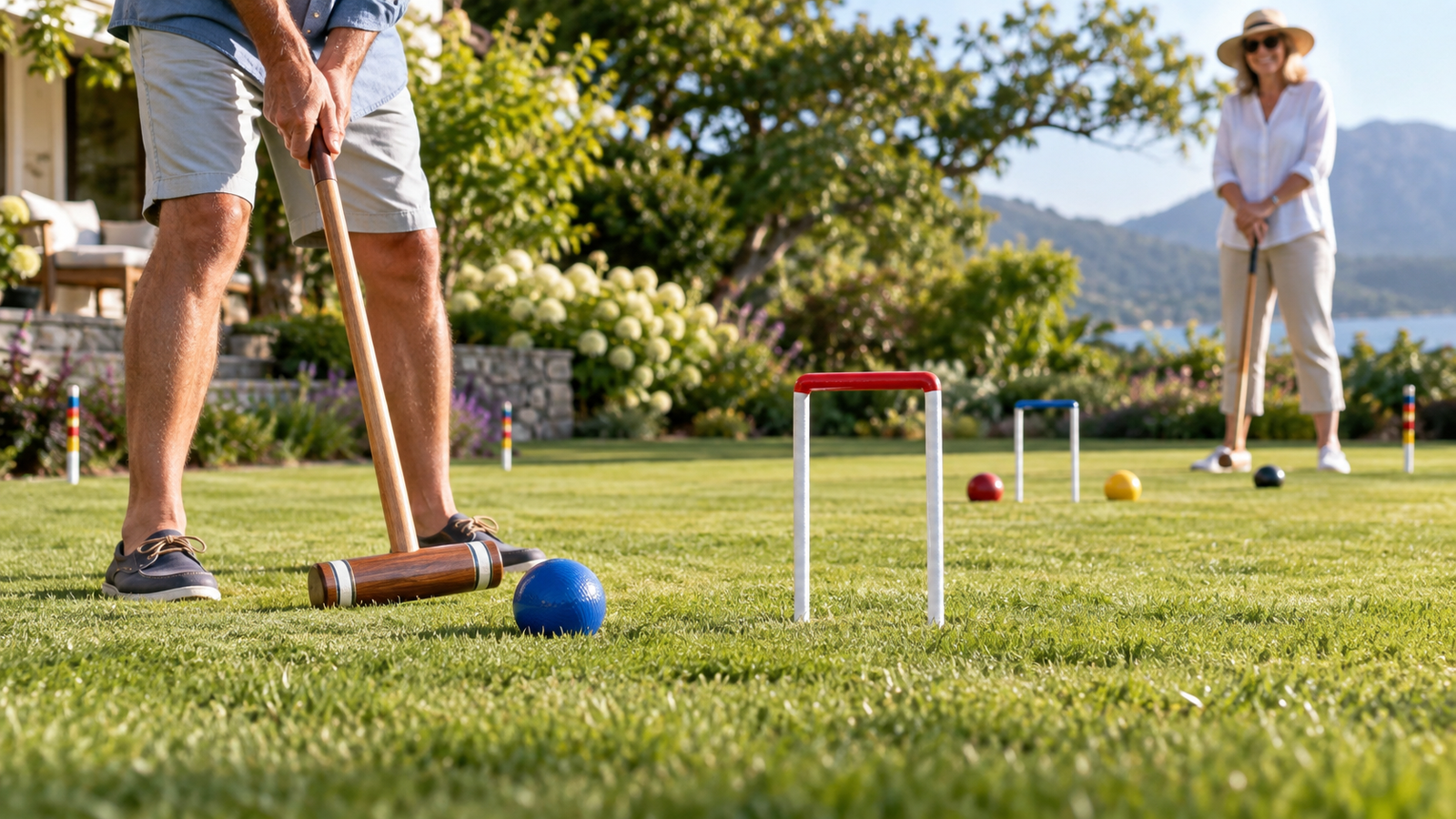
Croquet looks relaxed from a distance: a green lawn, colorful balls, and wooden mallets moving at an unhurried pace. Once play begins, however, beginners discover a precise game of angles, position, touch, and tactical choices. A powerful swing matters far less than a controlled stroke that leaves the ball ready for the next hoop. That blend of accessibility and depth is why croquet works at a family gathering, a casual backyard event, or a competitive club.
Several formal versions of croquet exist, and their rules are not identical. Association croquet and golf croquet are the best-known international disciplines, while many backyard sets use simplified nine-wicket rules. Before playing, identify the version your group wants. The guide below emphasizes beginner-friendly principles that apply widely, then shows how to build a fair course and improve basic technique.
Understand the objective
In every common version, players use a mallet to strike their own ball through a sequence of hoops or wickets. The winner is determined by completing the required course or earning the target number of hoop points. The exact order, turn rules, and interactions between balls depend on the format.
Golf croquet is especially easy to introduce. All players contest the same hoop in order; the first ball through earns that point, and play moves to the next hoop. Association croquet uses additional strokes earned through hoop running and contact with other balls, which creates longer tactical turns. Nine-wicket backyard croquet often sends balls through a double-diamond course and includes local rules. Write down those local choices before the match so no one learns a surprise rule halfway through.
Choose and inspect the equipment
A basic set includes mallets, balls, hoops or wire wickets, and boundary markers. Mallets should feel comfortable rather than heavy. The head must be secure, the striking faces reasonably flat, and the handle long enough for a relaxed stance. Balls should be easy to distinguish by color and similar in size and weight.
Place hoops firmly enough that they do not wobble when a ball touches them. Competitive hoops fit closely around a ball; recreational sets usually allow more space, which is appropriate for beginners and uneven lawns. Check the ground for holes, stones, irrigation heads, or steep slopes. Croquet does not require a perfect court, but hidden hazards can damage equipment or cause a fall.
Set up a practical backyard court
Use the flattest available rectangle and scale the layout to the space. A smaller court is better than squeezing full distances into an area with trees, furniture, or foot traffic. Keep boundaries several feet from walls and windows. If children or pets are present, create a clear zone around each player before any swing.
Measure hoop spacing consistently. On a casual court, exact tournament dimensions matter less than symmetry and a logical route. Walk the entire course in playing order before the first shot. Make sure each target is visible, identify out-of-bounds areas, and decide how balls will be replaced after leaving the court. A quick diagram can prevent repeated questions.
Hosts may encounter many kinds of game-related promotion while researching an event. If adults consider visiting here as a link to a betting platform, they should confirm local legality and age eligibility, review the service independently, and keep wagering separate from the friendly croquet match.
Learn a stable stance and grip
Most accuracy problems begin before the mallet moves. Stand with balanced feet, soft knees, and enough room for the mallet to swing freely. Align the shoulders and intended swing path with the target. Keep the head steady and look at the back of the ball during contact.
Several legal grip styles exist. Beginners can hold the mallet with hands close together and thumbs generally pointing down the handle, then allow the mallet to swing like a pendulum. Avoid steering with the wrists at the last moment. A smooth backswing, relaxed transition, and straight follow-through produce more reliable direction than a sudden hit.
Control distance before chasing power
Practice sending a ball to targets at short, medium, and long distances. Use the same tempo and change the length of the swing rather than forcing the mallet. Try to stop within one mallet length of each target. This simple drill develops the touch needed for hoop approaches and defensive placement.
Ground conditions change pace. Damp grass slows a ball, short dry grass speeds it, and slopes pull it away from a straight line. Roll or strike a few test balls before serious play. Notice how the ball behaves in both directions, because a gentle rise in one direction becomes a faster descent in the other.
Approach hoops at a useful angle
A ball passes most reliably when it approaches near the center line of the hoop. From a severe angle, the opening appears narrower and a small error causes a miss. Beginners often aim directly at a distant hoop even when the next shot would be easier from a different position. Think one stroke ahead: the current shot should create a comfortable approach, not merely reduce distance.
When close to a hoop, choose a precise target on the far side and commit to the line. Deceleration can twist the mallet face. A short, positive stroke is usually safer than a hesitant tap. If the ball hits a wire, observe which part made contact; that feedback tells you whether the line or pace needs adjustment.
Use position as defense
Croquet strategy is not only about scoring immediately. In golf croquet, a player may block the hoop, clear an opponent’s threatening ball, or take a position that prepares the next turn. The best choice depends on turn order and the location of every ball. Count how many opponents can act before your next chance.
A clearing shot should have a safe follow-up. Striking an opponent away is less helpful if your own ball also finishes out of position. Sometimes occupying the center line forces others to attempt difficult angles. At other times, a quiet position several feet away is more valuable than crowding the hoop. Watch experienced players and notice how often their important strokes stop rather than score.
Keep play safe, fair, and enjoyable
Only the active player should stand near the ball. Everyone else remains behind or well to the side of the swing. Never swing a mallet as a joke, and inspect loose heads or damaged handles immediately. Establish a turn order, boundary rule, and method for resolving a ball that moves accidentally. When uncertain, replace it as closely as possible and continue.
Online betting requires firmer boundaries. A link labeled betting should be considered only by eligible adults where lawful. Set a hard entertainment budget, never chase a loss, and do not present wagering as a way to improve the odds or enjoyment of a physical game.
Croquet rewards patience more than force. Begin with a clear ruleset, a safe court, and equipment suited to the players. Build a repeatable pendulum stroke, practice distance control, approach hoops from useful angles, and consider where the ball will finish. Those habits quickly turn random hits into intentional play. Whether the result is a relaxed afternoon or the start of competitive interest, the game becomes most satisfying when every stroke has a purpose.